XXXIX. L’ALPHABETUn alphabet bariolé, Dont chaque lettre était un masque, Fut l’abécédaire fantasque Qu’en mon enfance j’épelai.
Très longtemps je me rappelai,
Mieux que mes sabres et mon casque,
Un alphabet bariolé
Dont chaque lettre était un masque.
Aujourd’hui, mon cœur enjôlé,
Vibrant comme un tambour de basque,
Rêve un Arlequin bergamasque,
Traçant d’un corps arc-en-ciellé
Un alphabet bariolé.


XXXIX. THE ALPHABETA bizarrely colored alphabet, in which each letter was a disguise, was the bizarre book I learned to read from when in my childhood I spelled words out.
For a long, long time I remembered it,
better than my toy swords and helmet,
a bizarrely colored alphabet,
in which each letter was a disguise.
Today my heart, won by flattering words,
vibrating like a tambourine,
dreams of a Bergamasque Arlequin,
tracing out with his rainbowed body
a bizarrely colored alphabet.
NOTES (by line number, starting with the title)
1 This is rondel XI, otherwise untitled, in Rondels Bergamasques.
2 bariolé : « Qui est de diverses couleurs mal assorties ou fort tranchantes », ‘Which is of mismatched or very garish colors’ (DAf1878).
3 masque : Giraud may mean simply ‘mask’, perhaps with the characteristic masks of commedia dell’arte in mind. But he might also intend the natural generalization (vari-ously described in DAf since 1718) made as follows in DAf1878: « Une personne qui porte un masque pour se déguiser pendant le carnaval. Une compagnie, une troupe, une bande de masques », ‘A person who wears a mask to disguise himself during Carnival. A company, a troupe, a band of masks’. In that case the letters of his alphabet might have been similar to the historiated capitals in the Heures de Charles d’Angoulême.
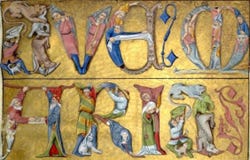
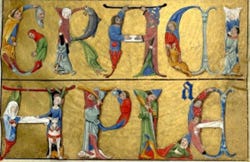
4 Fut : This, « épelai » in 5, and « rappelai » in 6, along with « joua » in XXLII.4, are the only instances in which Giraud uses the passé simple, an indicative tense « qui permet d’envisager dans sa totalité une action entièrement achevée au moment de l’énoncia-tion » (current DAf), ‘which allows envisaging in its totality an action entirely complet-ed at the moment of its enunciation’. It is one of the French temps de narration (narra-tive tenses).
fantasque : See III.1.
7 mes sabres et mon casque : Sabers and helmet, childish toys strongly gendered male.
11 tambour de basque : A tambourine; unlike the « basque » worn by Pierrot Dandy (III.10), in this phrasal idiom « basque » does refer to the Basque people.
12 Arlequin bergamasque : [Note to be completed.]
13 arc-en-ciellé : In RL1882, the hyphens are omitted. With or without the hyphens, the word (or phrase) is very rare, and may have been originated by Giraud.


